
Why companies invest heavily in technology, and too little in the systems required to turn it into business value.
The AI Paradox: More Technology, Less Value Than Expected
By 2028, AI agents may outnumber sales managers ten to one, according to Gartner. Yet fewer than 40 percent of sales managers are expected to say those agents improved their productivity. The problem is not adoption. It is about converting AI investment into measurable business value.
The AI Value Gap Is Real
Companies have largely solved the deployment problem. Now they have a value-capture problem. Gartner expects roughly 234 billion dollars in enterprise application spend to be exposed to agentic AI by 2030, about 20 percent of total enterprise software budgets. Boston Consulting Group shows the same pattern from a different angle: only about 5 percent of companies capture AI value at scale, while AI leaders achieve three times higher cost reductions than laggards. Around 60 percent still report little or no measurable value. AI activity and AI value are two different metrics, and most companies optimize for the wrong one.
The Inversion Problem: Investing in the Wrong Order
McKinsey offers a simple, well-supported explanation. Successful AI transformations follow a 1 to 3 to 5 ratio, one part technology, three parts process redesign, five parts capability building and adoption. In practice, most companies invert this ratio.
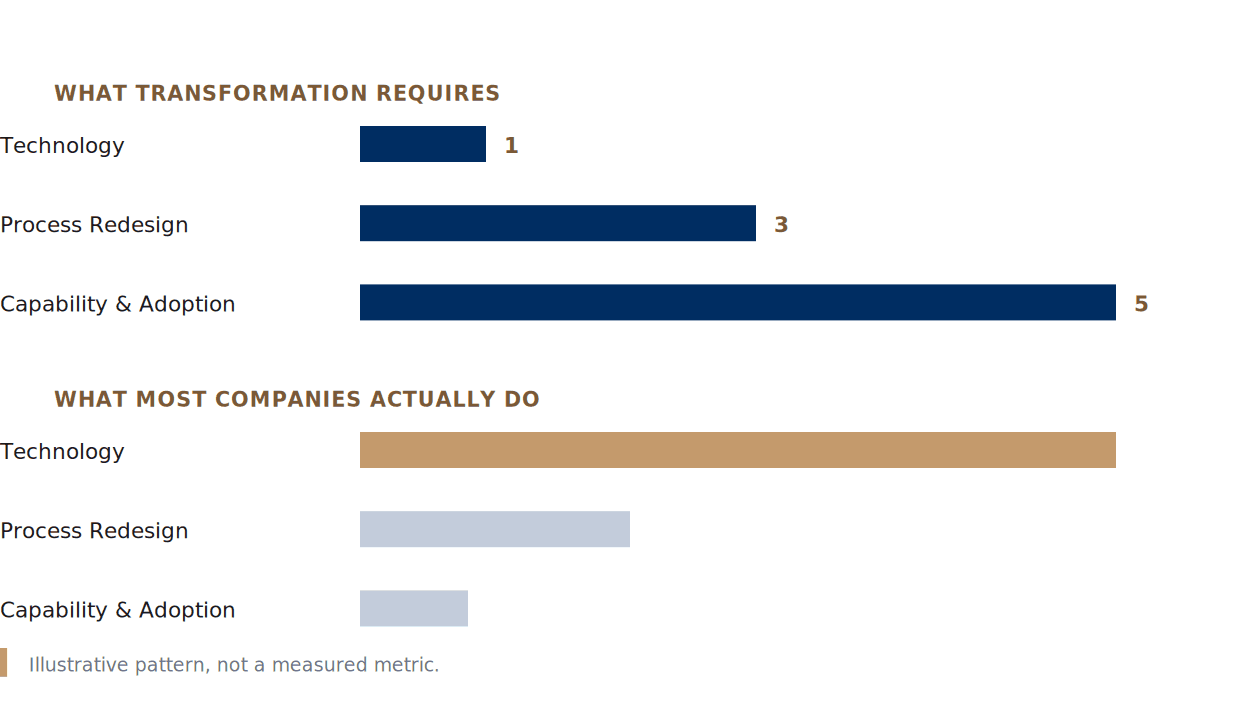
These figures are illustrative, not a measured formula, they describe a recurring organizational pattern.
Why AI Leaders Redesign the System Instead of Adding Another Tool
Companies with measurable AI value do not differ by having better models. They differ by the depth of integration. BCG and McKinsey independently reach the same conclusion: sustainable advantage comes from redesigning work, decision rights, and operating models, not from the mere availability of AI tools.
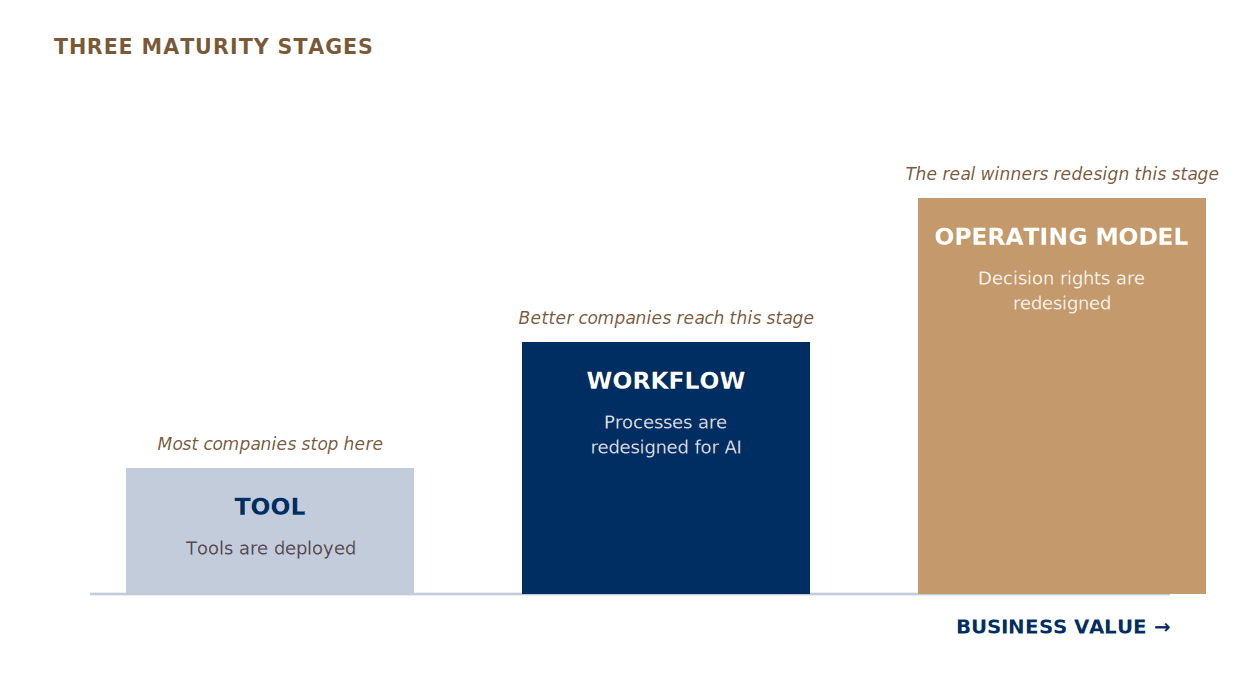
This maps to three maturity stages: tool, workflow, operating model. Most companies stay at the first stage, better companies reach the second, the real winners redesign the third.
What This Means for GTM Leaders
For GTM leaders, the decisive question shifts: not which tool to introduce next, but which processes and capabilities need to be built before a tool can create value at all. Governance belongs structurally inside this middle and outer layer, not as a separate topic beside it. An AI system that documents decisions defensibly and meets EU AI Act requirements is not an extra burden next to process redesign. It is part of it, redesigning processes for AI means building in traceability and accountability from the start.
Recommendation
Most AI strategies are measured by what has been deployed. The better question is what has been redesigned. Before investing in the next AI platform, it is worth examining the system around it.
Where is your AI value gap actually created, in technology, in processes, or in capability building? A strategy conversation brings clarity in 30 minutes.
Sources: Gartner (Agentic AI forecasts, 2026), Boston Consulting Group (AI Radar / AI value studies, 2026), McKinsey & Company (State of AI / 1:3:5 model, 2026).