
How international SaaS and AI companies systematically reduce perceived risk in DACH enterprise sales.
DACH go-to-market rarely fails because of missing localisation. It fails because of a proof architecture that doesn’t match the German buying process. That is the central argument of this second instalment.
In the first part of this series, we dismantled a common misconception: DACH market entry is not a translation task. Companies that simply carry their website, pitch deck, and sales arguments over into German haven’t achieved market readiness. They’ve only changed the language.
Different weighting, not two different worlds
A common but oversimplified explanation goes like this: international buying committees trust innovation and ROI, German buying committees trust references and reliability. As intuitive as that sounds, it’s far too absolute. A US enterprise buyer in banking or healthcare can be exceptionally risk-averse. A German scale-up can respond strongly to speed and innovation.
The real difference isn’t in the culture of the decision-makers. It’s in the institutional architecture of the decision itself. German enterprise and Mittelstand deals typically carry more structural mechanisms for risk reduction: more approval stages, more documented proof requirements, more consensus-building before the contract is signed. A proposal that, in a US sales cycle, moves straight from the department to signature often runs, in the German Mittelstand, through procurement, legal, IT security, and, depending on the use case, data protection or AI governance review as well, frequently with its own evidence requirements at every station. That shifts the weight of the buying process noticeably toward proof, regardless of how innovation-friendly the individual decision-makers are personally.
For international vendors, this means: DACH buying committees don’t ask for a different message. They ask for a different architecture of proof.
The DACH Trust Stack: four proof points instead of a checklist
This proof architecture can be broken down into four layers: the DACH Trust Stack. It effectively accompanies a proposal along the same path it takes internally at the customer: from sales through procurement and legal to IT and go-live.
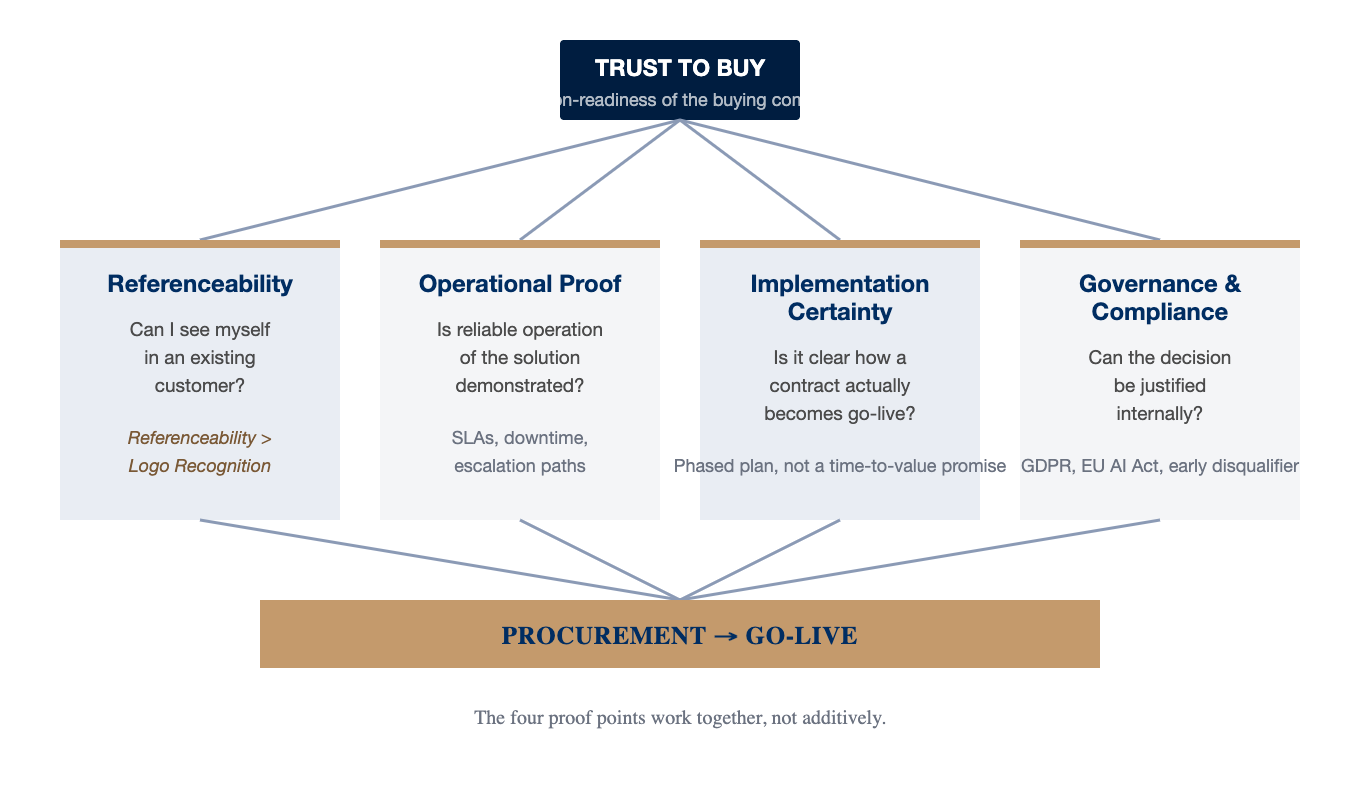
Referenceability. It isn’t the largest logo wall that decides. It’s whether the buying committee recognises itself in the reference customer: similar industry, similar company size, similar regulatory starting point. Referenceability beats logo recognition.
Operational proof. German decision-makers ask early and specifically about SLAs, downtime, support structures, and escalation paths. Vendors that only supply this information on request unintentionally signal that operational stability isn’t an integral part of their offering.
Implementation certainty. A clearly structured, phase-by-phase path from contract signature to go-live reduces perceived risk more effectively than any promise of pure time-to-value.
Governance & compliance. In many international sales cycles, compliance is a late-stage formality after commercial agreement. In German procurement processes, compliance is frequently an early disqualifying criterion. Vendors that only provide evidence of GDPR conformity or EU AI Act classification when asked lose time at a point in the cycle they can no longer make up later.
These four proof points work together, not additively. A strong reference portfolio doesn’t compensate for missing compliance documentation, and a clean implementation story doesn’t compensate for unresolved questions about operational stability. Only together do they produce what a German buying committee recognises as decision-ready, and only then does the cycle accelerate, instead of stalling again at one of the four stations.
What this means for your own GTM strategy
For international SaaS and AI companies selling into the German Mittelstand, this creates a clear priority. Building trust isn’t a byproduct of good positioning. It’s a standalone GTM capability that has to be prepared before the first sales contact, across all four layers of the Trust Stack, not only once procurement or legal ask for it.
In practice, that means curating the reference customer portfolio for comparability rather than brand recognition, documenting operational stability and implementation paths proactively rather than on request, and establishing compliance evidence as a fixed part of the early sales process rather than a late add-on. The effect is measurable where it counts: in cycle length, and in the number of deals lost during pre-selection.
How DACH-ready is your GTM engine?
The four layers of the DACH Trust Stack can be assessed in a structured way, before they become blockers in procurement. That’s exactly what the Cultural GTM Assessment, launching shortly, is built to do: a benchmark across referenceability, operational proof, implementation certainty, and governance & compliance, before these gaps put a live sales cycle at risk.
This article is the basis for the Market Launch DACH Trust Stack and expands on the Trust dimension of the Market Launch Cultural GTM Framework.